Complex infrastructure construction - "Gäbihübel" partial cabling
July 22, 2019
A 380-kilovolt high-voltage line was laid in the ground for the first time in the Bözberg/Riniken area. ERNE's civil engineering specialists tackled work on steep slopes, rocky outcrops and the crossing under the SBB railroad line and Bözbergstrasse.
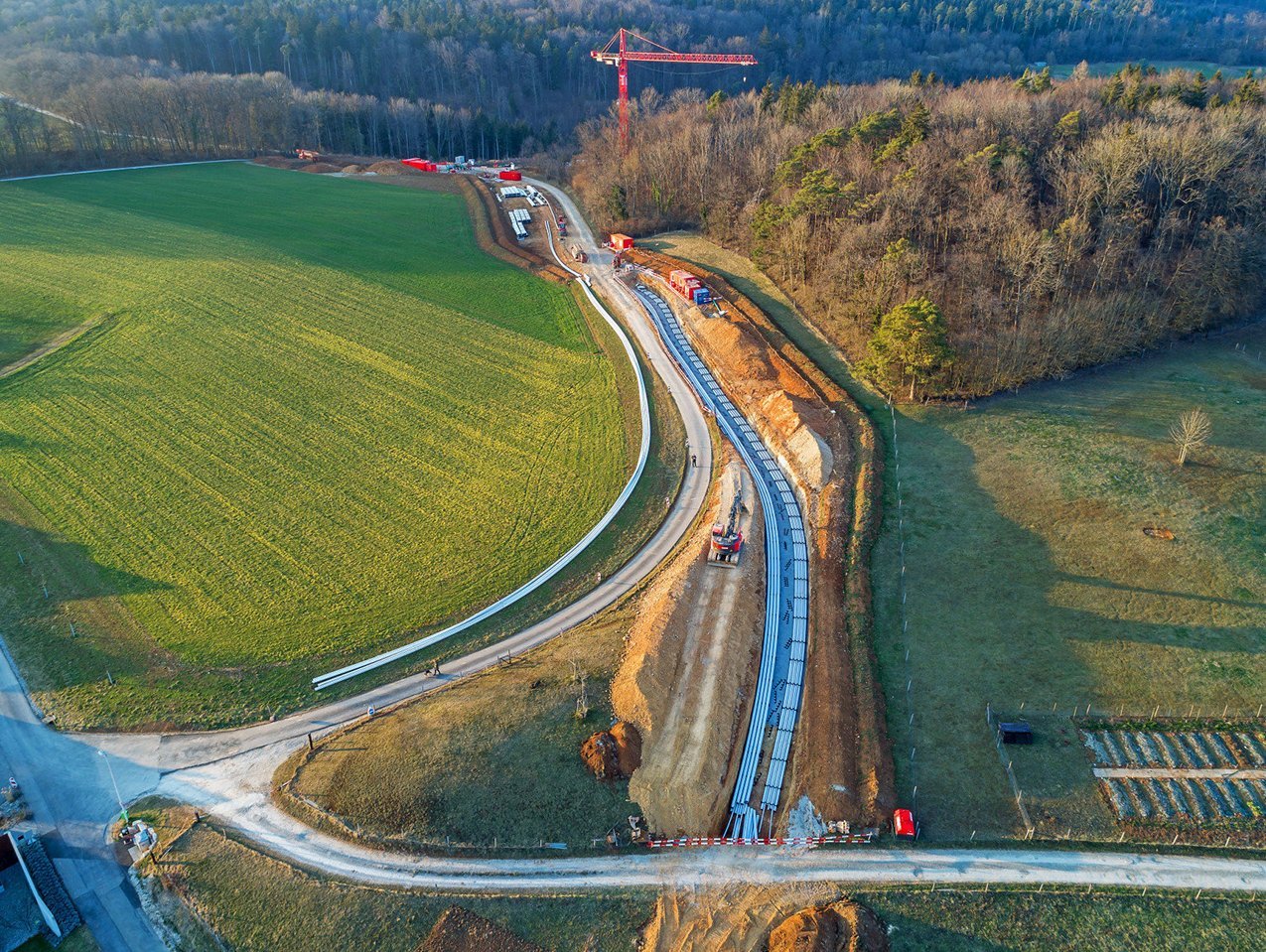
13 kilometers of cable conduits laid in the ground
As part of the "Strategic Grid 2025", the voltage of the lines between Beznau and Birr was increased from 220 to 380 kilovolts. With this project, Swissgrid AG aims to eliminate bottlenecks in the electricity supply and secure Switzerland's sustainable energy future. The power lines between Bözberg and Riniken were not routed above ground, as is usual for extra-high-voltage lines, but were laid underground for the first time. The "Gäbihübel" project was a first in Switzerland and was carried out by ERNE as a total contractor order. Together with Gebr. Meier AG Rohrleitungsbau, ERNE's civil engineering specialists laid around 25,500 meters of cable protection conduits at Gäbihübel.

Parallel work of building construction and civil engineering
In the northern and southern areas of Gäbihübel, the ERNE structural engineering team built two transition structures to connect the overhead line with the underground cable. The location for the approximately 1,000 m2 structures and 25-metre-high tensioning portals was carefully selected in order to preserve the landscape as much as possible. The north structure is shielded by a section of forest in the "Pfaffenfrist" area, while the south structure is located in the "Unterer Stockacker" area below the SBB railroad line. After completion of the reinforced concrete work, the ceilings of both structures were secured for driving on with a crane truck with approx. 200 ceiling supports. This then hoisted the individual parts of the bracing portals upwards so that they could be assembled by the steelworkers and anchored in the sleeve foundations. After alignment, the ERNE structural engineering team concreted the steel gantries into place.

Extensive earthworks in the area of the railroad line
In order to connect the two transition structures with the underground cables, the SBB railroad line had to be crossed underneath in the area of the southern structure, without interfering with train traffic. A challenge that the civil engineering specialists mastered perfectly using the so-called "microtunneling method". By laying the pipes without trenches, a large tunnel with a diameter of 2.4 meters was created under the railroad line. Due to rock deposits in individual sections of the tunnel length, the civil engineers were only able to advance 30 centimeters per day in some cases. The team encountered rocky terrain not only in the area of the SBB railroad line, but also in the vicinity of the northern structure, where material had to be removed with the rock cutter. The mild and dry weather in autumn 2018 favored the civil engineering work. The topsoil with the vegetation layers A and B could already be removed in some places in late fall and carefully deposited separately. This was important in order to cope with the prolonged period of rain in January without interrupting work: soaked topsoil must not be driven on in bad weather. This meant that work could continue in the new year in accordance with the construction program.

Joining forces in pipeline construction
Parallel to the work on the transition structures, ERNE AG Bauunternehmung, together with Gebr. Meier AG Rohrleitungsbau, laid the cable protection pipes in stages, in which the cables will later be routed. The ERNE civil engineers excavated a 5 meter wide and 2.5 meter deep cable trench in stages over a distance of 1.3 kilometers. As already mentioned, the critical points of the project included the undercrossing of the SBB railroad line and the undercrossing of Bözbergstrasse. Work on the road had to be carried out quickly so as not to restrict the flow of traffic on Bözbergstrasse, which is considered a heavy traffic route, for too long. Another tricky part was the construction of the cable block in the approx. 150 meter long steep slope. This section demanded the team's utmost attention.

Laying the cable conduit blocks
In order to lay the 1.5 meter wide pipe blocks efficiently, pipe strings consisting of socket-welded polyethylene pipes were created outside the trench in advance. All fitters on site had welding certification and reported each individual weld seam precisely to ensure quality. The specified cooling times had to be adhered to exactly and the resulting inner bead had to be thoroughly removed after each welding process. This ensured that the cables, which were later pulled in, could slide through the pipes easily and without being damaged. The prefabricated pipe strings were then brought together in several stages in the trench to form the cable pipe blocks. The ERNE civil engineering team then concreted the two pipe blocks and covered them again with the layers of topsoil that had been removed and deposited to the side.

Guided tour through the complex civil engineering project
The "Gäbihübel" project is the first of its kind in Switzerland and has attracted a great deal of public interest. The first underground cabling in the extra-high-voltage grid and the associated opportunities and challenges should therefore be presented to the public and made tangible. Swissgrid AG therefore had a temporary visitor center built in the "Spitz" area. The approximately 270 m2 building was constructed on site from container elements and has a complete infrastructure. For around three years, visitors and interested parties were able to experience the special features of the "Gäbihübel" project up close by making an appointment with Swissgrid.
ERNE AG Bauunternehmung and Gebr. Meier AG Rohrleitungsbau are proud to be part of the "Gäbihübel" project. With combined forces and great commitment, we have carried out this challenging and exciting project for Swissgrid.

Facts about the construction site
Object | Swissgrid AG, partial cabling of 380 kV line |
Services | Earthworks and route construction, line construction, special civil engineering and structural engineering (transition structures) |
Construction time | August 2018 - July 2019 |
Project participants ERNE | Project management: Gerhard Hauser, Site manager: Stefan Schoch, Andreas Hasler, Foreman: Manfred Nussbaum, Matthias Rohner |