Traffic area Bucher-Guyer-Areal
July 02, 2019
Hand in hand with demolition, civil engineering and pavement construction
ERNE realized a new traffic area for the Bucher-Guyer company on the company's eastern site in Niederweningen. Existing buildings were demolished and the subsoil was rebuilt for the subsequent pavement construction.

Demolition: buildings have to make way
Before the three factory buildings on the Bucher-Guyer site were dismantled, the specialists from the pollutant remediation department removed PCB-containing paintwork from steel beams as well as underlay floors, windows and skylights containing asbestos. The subsequent dismantling was carried out from the roof to the top edge of the existing floor slab. Flat wooden roofs, quarrystone and solid stone walls, lightweight walls and various plant components were dismantled. The dismantling paved the way for the ERNE civil engineering work.

Targeted ground work by the civil engineering team
In the front area of the site, next to the road, the ground had to be excavated. The soil was very "boggy" and it was only possible to drive the excavator over it after the subsoil had been covered with steel plates. The large Hitachi KMC 520 excavator, which has an extension, was then able to excavate from a slightly further distance than usual. Due to contamination in the soil and concrete, material had to be replaced in some places. The soil areas were divided up according to the degree of contamination before work began and temporarily deposited in individual batches on the construction site after excavation. A logistical masterstroke, as there was very little space available on the construction site for interim storage. What's more, the Bucher-Guyer site is located in two cantons! Different disposal regulations in the cantons of Zurich and Aargau required good planning of the processes. After assessment by the specialist site management for contaminated sites, the material was taken to the appropriate landfill.

During the excavation work, the civil engineers were surprised by an old 100,000-liter heating oil tank from 1900 with riveted plates. Next to it was an old sewer pipe that was still in operation and could not be damaged. The oil tank, which was still filled with dirt and oil, was sucked out with the ERNE-FANT suction excavator. The tank could then be neatly cut into individual parts and removed without damaging the existing sewer pipe. After the excavation work, the civil engineers reinforced the foundation layer in the areas without a concrete slab with double geogrids. This plastic mesh is placed on top of the subgrade or gravel layer, thereby stabilizing the subsoil.

New construction of the drainage system for the square
The square, which will later be asphalted, has a considerable surface area and the rainwater must be able to drain away quickly. The main sewer system cannot absorb the incoming water volumes all at once, so a new sewer system was built for the square. This feeds the water into the main sewer system via a retention structure. The excavation pit for the 1.5 meter high pipe had to be drained accordingly, as the work took place half a meter below the groundwater level. Two shafts were also built for the structure with an overflow edge, which collects the water during heavy rainfall and feeds it into the main sewer system with a delay. A shaft with a diameter of 2.5 meters and a special large shaft with a diameter of 3 meters.

Pavement construction and 2,000 square meters of asphalt reinforcement
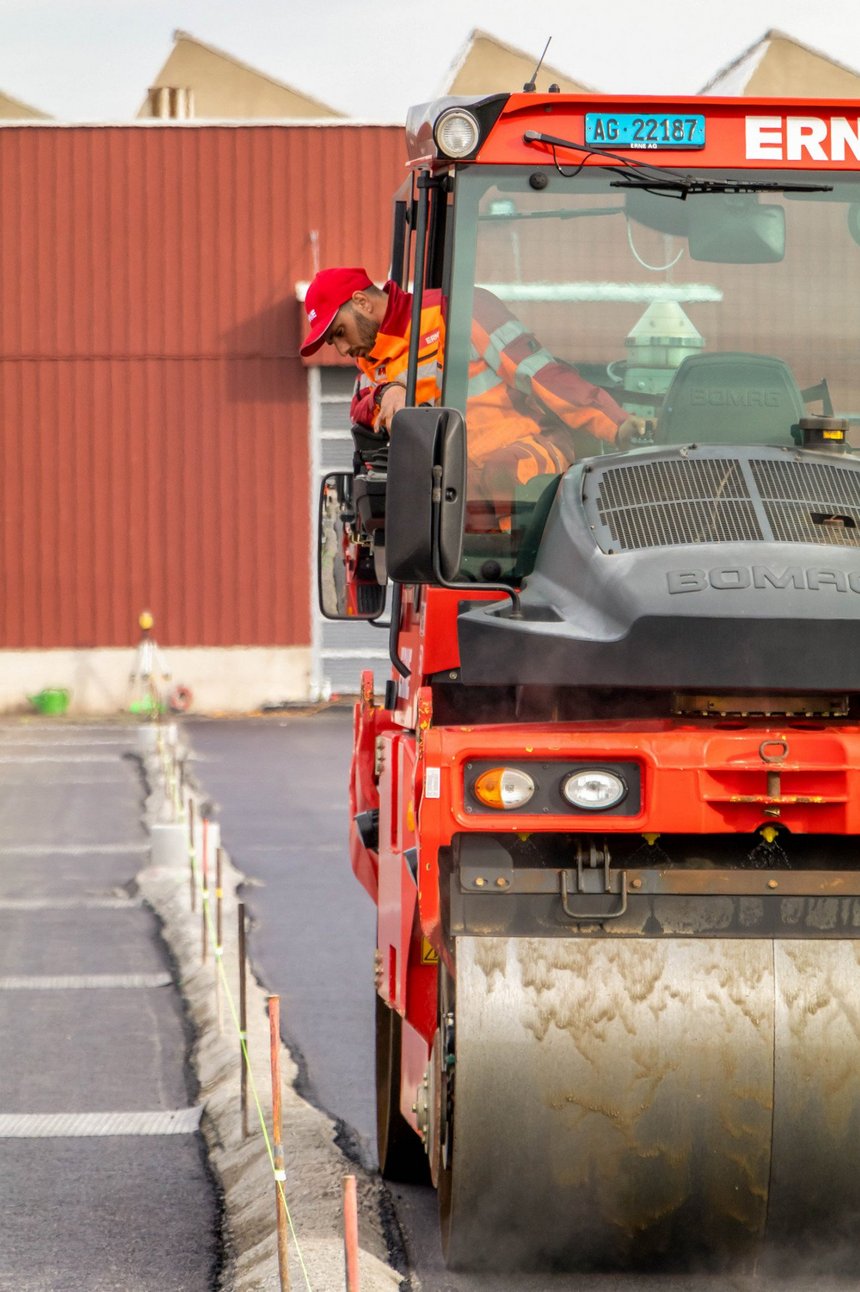
A total of 5,500 tons of surfacing and 2,000 square metres of asphalt reinforcement were then laid over the entire area. In places, up to fifty centimeters of pavement was laid to create a slope. As there had previously been a building on this site, the floor slab was horizontal. However, a slope was required for the site so that the water did not collect in puddles but could drain off to the side into the hydroblock channels. To install the channels, the specialists from the drilling and cutting department cut recesses in the existing floor slab. Asphalt reinforcement was laid at the construction joints of the concrete slabs to prevent cracking at these points.
The new traffic area of the site has already been handed over to the client. We would like to thank Bucher-Guyer for allowing us to carry out this exciting project.
Facts about the construction site
Object | Traffic concept Bucher-Guyer-Areal East |
Services | Pollutant clean-up, gutting and demolition as well as remediation of contaminated sites, pipeline, road and pavement construction |
Construction period | October 2018 to July 2019 |
Project participants ERNE | Site manager: Sebastian Harmutter, Foreman: Roman Müller, Beat Gentsch, Thomas Strittmatter |